On a daily basis, we are bombarded with news on climate change, whether through reports of broken temperature records, extreme weather events such as hurricane Katrina or the disappearing of polar bears. It is now accepted that we are experiencing global warming and that human activity is a contributing factor.
The single human activity that is having a large impact on the climate is the burning of fossil fuels such as coal, oil and gas.
Why alternative energy?
There is not enough oil in this world to continue at our current consumption rate. Eventually, our oil supply will stop and the world's economy stopping with it.
Also, with the support for ‘green’ movement, government and regulators of different countries are reacting by introducing legislation designed to reduce greenhouse gas emissions thus reducing the damaging impacts on our environment
This has prompted people to start looking at alternative energy such as solar, nuclear, ethanol, and biodiesel energies.
Some alternative energies are shown below:
Other possible alternatives are:
Geothermal
Tides
Hydroelectric
Let me elaborate on two of the alternative energies below:
Wind energy
Wind mill
Wind power is an alternative energy source that could be used without producing by-products that are harmful to nature. Harnessing the wind is highly dependent upon weather and location. The average wind velocity of Earth is around 9 m/sec. And the power that could be produced when a wind mill is facing the wind of 10 mi/hr. is around 50 watts.
How does a basic windmill works?
The fins of a windmill rotate in a vertical plane which is kept perpendicular to the wind by means of a tail fin. As wind flow crosses the blades of the windmill, it is forced to rotate and can be used to generate electricity.
Ethanol
What is ethanol?
Among the most touted alternatives is ethanol, an alternative fuel. Ethanol is not something completely new. Ethanol is an alcohol-based fuel made by fermenting and distilling crops that have been broken down into simple sugars. In the United States, ethanol is generally made from starch crops such as corn or sorghum. In Brazil, ethanol is made from sugar cane.
Facing high oil and gasoline prices, there is a call for new technologies to reduce oil consumption. General Motors, a leading maker of cars came up with flex-fuel vehicles that can run on gasoline or ethanol.
For now, ethanol is mostly a blending source to help lower the amount of oil consumed while providing for cleaner-burning fuel. But over time, it could grow in importance as an alternative fuel called E85. That's a blend of 85 percent ethanol and 15 percent gasoline, the mix preferred for flex-fuel vehicles.
How does it help the environment?
It burns cleaner than gasoline as it emits fewer greenhouse gases.
Monday, August 13, 2007
Alternative energies

Tuesday, August 7, 2007
What is a "green" building??
It is fashionable to go “green” these days. We have politicians, sport celebrities and pop stars getting excited about the “Save the Earth” movement.
In early July this year, star-studded Live Earth concerts kicked off in Sydney before moving to Tokyo, Shanghai, Johannesburg, Hamburg, London and Washington and then to New York and Rio de Janeiro where pop stars, politicians and Hollywood celebrities drummed home the dangers of global warming urge people to go green.. But why?
In the previous article, we have seen the effect of greenhouse gases that warm up the earth.
But what do you understand by a green building??
Is it this?
In its own way, buildings have a profound effect on the environment, which is why green building practices are so important to reduce and perhaps one day eliminate those impacts.
In the United States alone, buildings account for:
39% of total energy use
12% of total water consumption
68% of total electricity consumption
38% of total carbon dioxide emissions
Would green buildings be more expensive?
According to a study conducted in the United States, although the average premium for green buildings is about 2% more than conventional buildings, they are 28% more energy efficient. It is also noted that if green building features are incorporated during the earlier design stage, the cost will be much lower.
Why is Singapore into “green” building?
As Singapore is a city-state with limited natural resources, it is important for our buildings to be energy efficient. According to a report from National Climate Change Strategy, energy use in buildings made up 16% of Singapore’s energy demand in 2004. It is noted that air-conditioning forms a large part of energy consumption due to Singapore’s tropical climate.
Also, Singapore has limited water resources. It is important to encourage both domestic and non-domestic consumers to use water efficiently.
Singapore’s domestic per capita water consumption has reduced from 165 litres /day in 1999 to 160 litres /day in 2005. This is achieved partly through a series of community outreach programmes conducted by Public Utilities Board (PUB) such as:
• Water Efficient Homes Programme
• Water Efficient Buildings Programme
• Water conservation talks and exhibitions
• Installation of dual flush low capacity flushing cisterns in toilets
• Installation of thimbles/constant flow regulators at water fittings
Emphasis of “green” building
Green building often emphasizes the use of renewable resources, e.g., using sunlight through solar cells, and using plants and trees through green roofs, rain gardens, and for reduction of rainwater run-off.
Following are some articles from Straits Times that might be helpful to you.

Thursday, August 2, 2007
Mother Earth is getting too HOT to handle. Can you help?
Measurements of temperature taken by instruments all over the world, on land and at sea have revealed that during the 20th century the Earth's surface and lowest part of the atmosphere warmed up on average by about 0.6°C. During this period, man-made emissions of greenhouse gases, including carbon dioxide, methane and nitrous oxide have increased, largely as a result of the burning of fossil fuels for energy and transportation, and land use changes including deforestation for agriculture. Global warming is now considered most probably to be due to the increases in greenhouse gas emissions and concurrent increases in atmospheric greenhouse gas concentrations, which have enhanced the Earth's natural greenhouse effect.
If the climate changes as current computer models have projected, global average surface temperature could be anywhere from 1.4 to 5.8 deg C higher by the end of the 21st century than in 1990. To put this temperature change into context, the increase in global average surface temperature which brought the Earth out of the last major ice age 14,000 years ago was of the order of 4 to 5 deg C. Such a rapid change in climate will probably be too great to allow many ecosystems to suitably adapt, and the rate of species extinction will most likely increase. In addition to impacts on wildlife and species biodiversity, human agriculture, forestry, water resources and health will all be affected. Such impacts will be related to changes in precipitation (rainfall and snowfall), sea level, and the frequency and intensity of extreme weather events, resulting from global warming.
In practical terms, each of us can help reducing global warming in changing our way of using resources, particularly fossil-fuel-derived energy, more efficiently, re-using and recycling products where possible, and developing renewable forms of energy which are inexhaustible and do not pollute the atmosphere.
Do you feel the pressure??
 But why don't we feel the atmospheric pressure? It is because within our body there is also similar pressure exerted out. You experience popping sensations in your ears when you are travelling in a lift to a very tall floor. Your body is equalizing the difference in pressure in environment. Aircraft cabins need to be pressurized at sea level when flying at high altitude for our comfort. At high altitudes like at top of mountain where air pressure is lower, there is pressure difference between body and atmospheric pressure. Breathing becomes difficult and nose bleeding may occur.
How can you demonstrate the effect of atmospheric pressure? Simply place a few sheets of newspaper are placed over a wooden ruler on the edge of a desk. A sharp blow breaks the ruler in half. Do get your science teacher to help you in this simple demonstration. It will be really cool if you can do this in your group presentation.
Brain-Teaser: You are in a space craft and falls into space (vacuum) accidentally? Will you survive out there?
Tuesday, July 24, 2007
Gee-Force!!
You have learnt recently that a change in velocity of any object will cause it to accelerate. Acceleration is known as the rate of change of velocity with time. The changing direction, increasing speed, decreasing speed of an object are all factors of acceleration.
In general, high velocity doesn't cause harmful injuries. But what is dangerous is the high levels of acceleration or deceleration over a certain time interval. The common term "G-force" is a measure of acceleration and is not a measure of force eventhough the term 'force' is associated with its name.

Under normal conditions on Earth, a body (standing or sitting) will experience 1G, which is derived from multiplying the body's weight by 1. For example, in roller coasters, the only time you feel 1 G is in the loading station and on the chain lift. Everywhere else, the rider’s body will be subjected to varying G-force due to the dips and crests. Similarly, when a pilot in an airplane changes its orientation rapidly (tight turns, loops, etc.), the aircraft and pilot will undergo additional G-forces.

There are 2 kinds of G-force, positive and negative. They are caused by different conditions and will result in different effects on the human body. For pilots, they will experience positive G-force as the airplane pitches upwards (the nose pulls up) sharply. In roller coasters, the bodies will experience positive G-force at the roller coaster dips or troughs, pushing the bodies into their seats. Under this condition, the blood may rush away from the head to the feet, probably causing greyouts or blackouts to the riders at high G-force levels.
Click here to see a fighter pilot experience a blackout.
For negative G-force, pilots will experience it as they nose dive the airplanes (pitch downwards). Riders in a roller coaster will feel negative G-force at the crests of the tracks where they may experience momentary weightlessness due to the lack of contact force by the seat. Excessive negative G-force will cause the body to experience red-out where excessive blood is pumped to the brain, causing distorted vision. It is normally preceded with a pink-out.
Click here to see boy experience state of weightlessness on an amusement park ride.
Roller coasters give humans a thrill ride. They undergo G-forces of maximum up to 3 to 4Gs for brief periods of time. Pilots on the other hand are trained to undergo accelerations of 9Gs to pull quick maneuvers during flight for less than a second. If a force of 4 to 6Gs is held for more than a few seconds, the results could be devastating; such as blackouts to death. The devastating car crash of Princess Diana of Wales in 1997 was estimated to range somewhere between 70 - 100Gs. This accident was intense enough to pull the pulmonary artery from her heart.
Click here for another interesting video of a pilot experiencing more than 10Gs in his fighter jet.
You may want to explore further on the effects of G-force on the human body and what are some preventive measures that are taken to lessen the effects of G-force on the body especially for fighter pilots. It was said that even sneezing exerts a G-force of 2.5G on the human body. So how much G-force can a human tolerate?
Adapted from :
http://www.furball.warbirdsiii.com/krod/basic-physics.html, http://www.geocities.com/CapeCanaveral/6795/physics.html, http://hypertextbook.com/facts/2004/YuriyRafailov.shtml
What is weightlessness?
Astronauts orbiting the Earth experience sensations of weightlessness similar to that felt by anyone who has been temporarily suspended above their seat on any amusement park ride like the roller-coaster.
Before understanding weightlessness, you must be able to understand the difference between contact forces and non-contact forces. As an example, when you sit on a chair, you will experience two forces, that are the pull of gravity on your body downwards towards the Earth (non-contact force) and the force of the chair pushing you upwards also known as normal force (contact force). Bear in mind that contact forces can only result from the actual touching of the two interacting objects, which in this case is the chair and your rear end. The force of gravity (non-contact force), on the other hand, can never be felt. Therefore, without a contact force, there is no means of feeling the effect of non-contact force.

Weightlessness is simply a sensation experienced by an individual when there are no external objects touching one's body and exerting a push or pull on it. In other words, it occurs when all contact forces are removed like when you are momentarily (or perpetually) in a state of free fall where the only force acting on your body is the force of gravity (non-contact force).
Even when you are undergoing free fall while sitting on a chair, there will be no contact force exerted on you by the chair as it is falling at the same rate as your body. Similarly astronauts and objects in space experience weightlessness as they are constantly falling at the same rate and no contact forces are present.

Here is a video of a dog experiencing weightlessness momentarily as it travelled unbuckled in a plane. There is also a video of how water behaves under weightless conditions.
Click here to view flying dog video.
Click here to view suspended water video.
You may want to explore the internet further for information on what are the effects of weightlessness on human beings especially for astronauts who undergo long periods of weightlessness. You may also want to find out more about common misconceptions about weightlessness.
Adapted from http://www.physicsclassroom.com/Class/circles/U6L4d.html
Saturday, July 21, 2007
Can Man travel at the speed of light?
In the Star Wars movie, ships could travel faster than the speed of light - cutting travelling time between galaxies and planets from years to minutes (imagine just taking a few days to reach the planet Mars for a holiday, wonderful right??!) , but then being all future scientists, Ponder for a moment: "is this possible in real life?" (even with future advancements in technology of course)
The speed of light, usually represented by the symbol "c" is exactly 299,792,458 metres travelled in 1 second and understandably, it is not easy to visualize how fast this is so we shall start with this. =)
One way to help all of us imagine would be to use the diagram below: 
The picture shows how short is the time (yes, 1 plus second) light takes to travel the distance between the Earth and the Moon. (a distance of 384,403 kilometres)
To explain the answer to whether can we travel faster than light or not, we'll use a formula (which I'm sure most of us have seen before but don't really understand) from Einstein's theory of relativity to put forward a simple proof =)
Einstein's theory of relativity states that:
where for any object, m refers to its mass, c refers to its speed and E the energy the object possesses.
oki, so what about the formula?
Einstein's relativity theory imposes a maximum limit to attainable speeds in the universe which means The law of relativity shows that the closer you get to moving at the speed of light, the higher the mass you have, and so the more energy you need to maintain your speed (and even more to keep getting faster). At the speed of light you will have infinite mass and so need infinite energy to be going that fast and that eventually you need infinite amounts of energy to accelerate infinite mass past the speed of light! (and as far as we know we have yet to find an infinite source of energy)
Just by way of comparison, the fastest speed ever achieved by an aircraft was 7,232 km/hour (Mach 6.7 - 6.7times the speed of sound) set by the experimental rocket-powered X-15 aircraft. That's 0.0000067 of the speed of light which really hints to us how far we're from hitting the speed of light.
X-15 Aircraft in flight.
All right, now for something additional =)
Have you ever wondered what will happen if we do travel faster than the speed of light?
(hint: our understanding of time changes !)
We can rely on the Special Theory of Relativity (Einstein 1905) and according to it :time in a moving reference frame (say your space ship) goes slower as compared to a stationary frame (say Earth) the faster you go.
So you see when you start off - at zero speed (0% of speed of light) your time is just regular i.e. the time slowing factor (xt) is equal to 1. As you speed up your time runs slower by the factor shown on the y-axis. As you are approaching 100% of the speed of light your time slows more and more until it is infinitely slowed down. (You should realize that everything slows down including your heart beats, your thoughts, etc.) So for an example if your ship goes at 98% of the speed of light and you take a one year journey, when you return to Earth five years have gone by.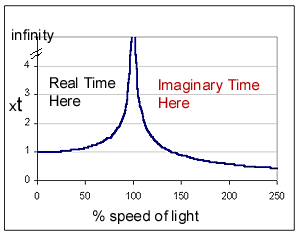
Another interesting phenomenon would be that if information could travel faster than c in one reference frame, causality would be violated: in some other reference frames, the information would be received before it had been sent (I'd receive a message from you even you have even sent out the message in your time of reference), so the 'effect' could be observed before the 'cause'.
Of course, there're much more to explore in possible effects if we do travel faster than time. If you're interested, this could be a possible area to research for your presentation. (hint: its under Quantum Physics)
xoxoxoxoxoxo
Science Teachers of LSS1
Thursday, July 19, 2007
How did S.I. units come about?
The earliest known uniform systems of weights and measures seem to have all been created sometime in the 3rd millennia BC among the ancient peoples of Egypt and Mesopotamia.
A typical measurement system would be based on the use of parts of the body and the natural surroundings as measuring instruments. Early Babylonian and Egyptian records indicate that length was first measured with the forearm, hand, or finger and that time was measured by the periods of the sun, moon, and other heavenly bodies.
For example, the cubit:

Even the carat, still used as a unit for gems (especially diamonds), was derived from the carob seed and have seen numerous changes. Nowadays as a standardization, One Carat= 200 milligrams, or 0.2 grams.
A brief comparisation of diamond size and carat

However, the numerous civilzations and their measurement systems created a problem: Too many system of measurements which invariably lead to confusion and in worse cases, chaos.
Just considering the Cubit, we've the Egyptian cubit and the Mesopotamian cubit for a start. There were several cubits of different magnitudes that were used. The common cubit was the length of the forearm from the elbow to the tip of the middle finger. It was divided into the span of the hand (one-half cubit), the palm or width of the hand (one sixth), and the digit or width of a finger (one twenty-fourth). But even this detailed definition created problems: Almost everyone had different lengths of fingers, forearms and elbows!
Other measures of length used in ancient times included in India: the dhanus (bow), the krosa (cry, or cow-call) and the jojana (stage) while the Romans and Greeks contributed the foot, unicae, inchs, mile, pace, Roman mile, furlongs, yards, gird and so on, adding to the confusion.
Looking at Units of mass: people had to sort through the confusion of the units of: the grain, pound, mina, shekel, talent, libra, troy pound, ounce, uncia, carat, carob, stone, quarter, hundredweight, tonnes, long tonne just for a start =) if they ever needed to do exchange or trade.
Among the mess, groups of scientists sought to unify a system of units for common usage throughout the world, and it was only in 1960 (yes, after centuries of confusion) during The 11th General Conference on Weights and Measures, we adopted the name Système International d'Unités (International System of Units, international abbreviation S.I.), for the recommended practical system of units of measurement which includes the base units of seven well defined units: the kilogram, metre, second, ampere, kelvin, mole and the
candela and as such, the S.I system of units is still currently adopted by people around the world today.
You can find more information about the S.I. units at:
Bureau International des Poids et Mesures at http://www.bipm.org/en/si/
For a more detailed explanation of how scientists proceeded to setting the S.I measurement system into practice, you can go to: http://www.bipm.org/en/si/history-si/
Tuesday, July 17, 2007
Welcome back! (^_^)
This time round however, there’ll NOT be a test/quiz for all. Rather, we’ll all do something more fun and entertaining. (^o^)
Students will form groups (your Science teacher will discuss this with you in class) and each group will select ONE of the articles posted and make a 10 minutes group presentation so everyone can learn from each other!
things to note:
(1) presentations will be during week 07 – 09 during lab periods.
(2) articles will be updated till week 07 so do stay tuned!
(3) to reward students for their efforts, 10% of CA2 grade will be given to the presentation, so work hard!
xoxoxoxoxo
Sec 1 sci teachers
Thursday, June 28, 2007
Goby
Welcome back to school! Have you been Mapling during the June holidays instead of doing revisions and your holiday assignments? School has started and time to put away your games for the moment.
This will be an article on Goby. Yes, the fish that comes out of the Bombing Fish House when it's dead. You'll meet it if you're on your way to Sotong..... For those who does not Maple, Goby is a type of fish that is summoned by the Bombing Fish House that looks like this (A bundle of Goby is the drop item when it's dead):

So how does the real-life Goby look like? It doesn't actually swim in that manner as you see it in Maple.


These are only four types of Goby. There are in fact more than 2000 species. Gobies can be found in shallow marine habitats including tide pools, coral reefs, and seagrass meadows, brackish water, lower reaches of rivers, mangrove swamps, and salt marshes. A small number of gobies (unknown exactly, but in the low hundreds) are also fully adapted to freshwater environments. These include the Asian river gobies, the Australian desert goby, and the European freshwater goby.
The most distinctive aspect of goby are the fused pelvic fins that form a disc-shaped sucker. Gobies can often be seen using the sucker to adhere to rocks and corals, and in an aquarium, they will happily stick to glass walls of the tank as well.
They are relatively small, measuring to about 10 cm in length. There are some exceptional species that can grow up to 30 cm in length. Humans do not eat them as food, but are preyed by cod, haddock, sea bass and flatfish as food. Goby feed on small animals.
Goby can be found mainly on the sand floor. Some swims around the coral, some lives in a hole dug by shrimps. Both the shrimp and goby lives together in close association. The shrimp maintains a burrow in the sand in which both the shrimp and the goby fish live. The shrimp has poor eyesight compared to the goby, but if it sees or feels the goby suddenly swim into the burrow, it will follow. The goby and shrimp keep in contact with each other, the shrimp using its antennae, and the goby flicking the shrimp with its tail when alarmed. These gobies are thus sometimes known as watchman gobies. Each party gains from this relationship: the shrimp gets a warning of approaching danger, and the goby gets a safe home and a place to lay its eggs.
Gobies are known as "cleaner gobies", remove parasites from the skin, fins, mouth, and gills of a wide variety of large fish. The most remarkable aspect of this symbiosis is that many of the fish that visit the cleaner gobies' cleaning station would otherwise treat such small fish as food (for example groupers and snappers). Again, this is a relationship where both parties gain: the gobies get a continual supply of food as big fish visit their cleaning stations, and the big fish leave the cleaning station healthier than they were when they arrived. This kind of relationship is known as MUTUALISM (both parties benefit). You will learn more under Ecology in Sec 2.
Several species of goby are kept as pets by us! The bumblebee gobies, genus Brachygobius are perhaps the most widely traded examples, being small, colourful, and easy to care for. They need tropical, hard and alkaline freshwater or slightly brackish conditions to do well. Gobies are generally peaceful towards their tankmates though territorial among themselves. Since most are small and few are predatory towards other fishes, they usually make good community fishes (meaning they don't eat other fishes in the tank).
Typically, the main problem with gobies is feeding them: with a few exceptions, the small species kept in the tank prefer live or frozen foods rather than flake, and they are not very good at competing with active species such as cichlids. It is often recommended that gobies be kept on their own or with peaceful surface dwelling species such as halfbeaks and guppies.
Find out more on other species of Goby and other fishes HERE.
Sunday, June 3, 2007
African Wild Ass - Critically Endangered (Contributed by Kai Xiang 1C)
The African Wild Ass is a wild member of the horse family. This species is believed to be the ancestor of the domestic donkey which is usually placed within the same species. They live in the deserts and other arid areas of northeastern Africa, in Eritrea, Ethiopia and Somalia; it formerly had a wider range north and west into Sudan, Egypt and Libya. The upper parts of the African wild ass are gray; the mane is sparse but erect; and it has variable transverse leg stripes.
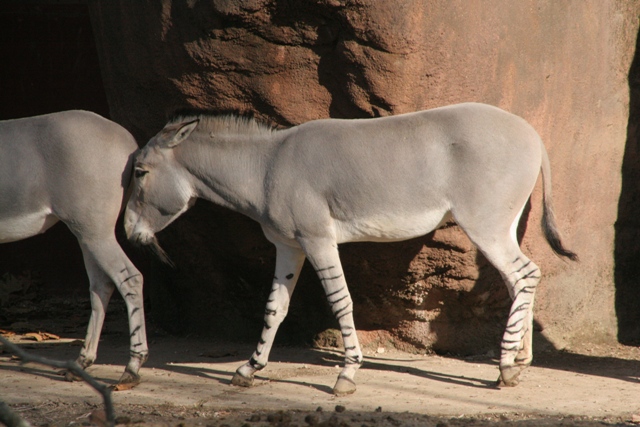
It has a length of about 2 m and weighs about 200 kg. The African wild ass is found mostly in hilly and stony deserts. It is an herbivore. Although the African wild ass is well adapted to life in the desert, it still needs access to water. It appears to be more active when the weather is cooler.
The African wild ass lives in groups that composed of fewer than 5 members. The groups are small due to the fact that food where the African wild ass is found is not suitable to support large groups. Adults males are often found living alone. However they may sometimes live in groups with other males. Females and their offspring are often found living together.
African wild asses are well suited to life in a desert or semi-desert environment. The diet of African Wild Asses consists of grasses, bark, and leaves. Despite being primarily adapted for living in an arid climate, African Wild Asses are dependent on water, and when not receiving the needed moisture from vegetation they must drink at least once every three days. However, they can survive on a surprisingly small amount of liquid, and have been reported to drink salty or brackish water. They have tough digestive systems, which can break down desert vegetation and extract moisture from food efficiently. They can also go without water for a fairly long time.
Their large ears give them an excellent sense of hearing and help in cooling. They have very loud voices, which can be heard for over 3 km, which helps them to keep in contact with other asses over the wide spaces of the desert.
Wild asses can run swiftly, almost as fast as a horse. However, unlike most hoofed mammals, their tendency is to not to flee right away from a potentially dangerous situation, but to investigate first before deciding what to do. When they need to they can defend themselves with kicks from both their front and hind legs.
The causes that result in the African wild ass becoming endangered are as follow: hunting the wild ass for food and medicinal purposes, potential competition with livestock for forage and water, and interbreeding with the domestic donkey.
Number of wild African wild ass in the world:
1968: few hundreds
1971: 3000
Early 1970's: 1500
1983: 2000
1992: Few hundreds
1997: Possibly only a few hundred animals
2002: Less than 570
The African wild ass is legally protected in the countries within which it is currently found, although these measures often prove difficult to enforce. More effective protection measures need to be adopted if the status of this species is to improve. A protected population of the Somali wild ass exists in the Yotvata Hai-Bar Nature Reserve in Israel, to the north of Elat. This reserve was established in 1968 with the view to bolster populations of endangered desert species. Populations of horses and asses are fairly resilient, and if the species is properly protected it may well recover from its current low.
Can you name other endangered species in the world?
Sunday, April 22, 2007
Questions
Dear students, your first mid-year examinations are just round the corner. You can post questions on the Sec 1 topics that you have learnt. Please post them under "Comments" in this post ONLY.
In order not to have your questions missed, please start revising now and send in your questions early. We will not entertain last minute questions. Also, please wait patiently for your answers. ^_^
Check out the new links under "Interesting Links". Some of them are add-ons to your Sec 1 syllabus!
Wednesday, March 28, 2007
Pretty Fireflies
Congrats on completing the Science Blog quiz. =) Please come check this blog once in a while to further your general knowledge on science and hope the new articles will be more interesting to you. Your feedback on the survey will be looked upon for further improvements to the blog. Happy reading! 
Have you ever wondered how fireflies glow in the dark and why do they glow? They make use of bioluminescence! Bioluminescence is the ability of living things to emit light. It is found in many marine animals, both invertebrates (e.g., some cnidarians, crustaceans, squid) and vertebrates (some fishes); some terrestrial animals (e.g., fireflies, some centipedes); some fungi and bacteria (photo at left).
Fireflies use their flashes to attract mates or prey. The pattern differs from species to species. In one species, the females sometimes mimic the pattern used by females of another species. When the males of the second species respond to these "femmes fatales", they are eaten!
The firefly is capable of producing a "cold light" containing no ultra violet rays, with a wavelength from 510 to 670 nanometers, pale yellowish or reddish green in color, with a lighting efficiency of 96%.
There are more than 2000 species of firefly, found in temperate and tropical environments around the world. Many species can be found in marshes or in wet, wooded areas where their larvae have more abundant sources of food.
The luminescence involves a luciferin (a light-emitting substrate), a luciferase (an enzyme that catalyzes the reaction), ATP (the source of energy) and molecular oxygen. Generally, the more ATP is available, the brighter the light.
How fireflies turn their luminescent organs — called lanterns — on:
1.The luminescent cells of the lanterns are close to cells at the end of the tracheoles (that bring oxygen to — and take carbon dioxide away from — the insect's tissues).
2. These cells contain nitric oxide synthase (NOS), the enzyme that liberates the gas nitric oxide (NO) from arginine.
3. Nerve impulses activate the release of NO from these cells.
4. The NO diffuses into the lantern cells and inhibits cellular respiration in the mitochondria (probably by blocking the action of cytochrome c oxidase)
5. With cellular respiration inhibited, the oxygen content of the cells increases.
6. This turns on light production in the peroxisomes that contain luciferase and luciferin-ATP (the ATP is generated when the lanterns are dark).
7. The quick decay of NO probably contributes to the short duration of the flash.
Wednesday, February 28, 2007
Armoured Sea Robin - Contributed by Leon Jin (1L)
Description—
The armored robin resembles the sea robins in general body form, and in the arrangement of its fins, including the fact that the two lower rays of each pectoral form separate feelers. But its body is entirely clothed with bony plates of considerable size. There are 4 rows of these on each side, from the vent rearward, with an equal number of rows of thornlike spines, the latter close set and directed rearward. The plates on the abdomen have no spines. Thanks to this armor, the trunk is very stiff. The lower jaw bears a number of short fleshy barbels; there is one long barbel with short side branches at each corner of the mouth; and the front of its head is given so peculiar an appearance by the two projections from the skull that the armored robin could hardly be mistaken for any other fish, except for one of its own tribe.
Color—
Bright crimson, below and above.
Size—
Maximum recorded length between 13 and 14 inches (330-355 mm.).
Habits —
This is a ground fish, recorded from depths ranging from 50 fathoms down to somewhere between 200 and 235 fathoms. And it seems to be confined to the zone of warm water along the outer part of the continental shelf and upper part of the continental slope for the lowest temperature in which it has been recorded is between 44° and 45°. The stomachs of those that have been opened contained shrimps, stomatopods, and other small crustaceans.

Saturday, February 24, 2007
Cloning II
Should Humans be Cloned?
Physicians from the American Medical Association and scientists with the American Association for the Advancement of Science have issued formal public statements advising against human reproductive cloning. Currently, the U.S. Congress is considering the passage of legislation that could ban human cloning.
Due to the inefficiency of animal cloning (only about 1 or 2 viable offspring for every 100 experiments) and the lack of understanding about reproductive cloning, many scientists and physicians strongly believe that it would be unethical to attempt to clone humans. Several cloned animals have died prematurely from infections and other complications. The same problems would be expected in human cloning. In addition, scientists do not know how cloning could impact mental development. While factors such as intellect and mood may not be as important for a cow or a mouse, they are crucial for the development of healthy humans. With so many unknowns concerning reproductive cloning, the attempt to clone humans at this time is considered potentially dangerous and ethically irresponsible.
With the many unethical issues, why are we still so concerned over cloning? It must have its advantages and uses!
Technology related to cloning can be used to improve taste and nutritional value or provide resistance to particular types of disease can be used to genetically engineer food crops. Animals can be genetically altered to serve as models for studying human diseases.
Reproductive cloning also could be used to repopulate endangered animals or animals that are difficult to breed.Cloning extinct animals presents a much greater challenge to scientists because the egg and the surrogate needed to create the cloned embryo would be of a species different from the clone.
Therapeutic cloning technology may some day be used in humans to produce whole organs from single cells or to produce healthy cells that can replace damaged cells in degenerative diseases such as Alzheimer's or Parkinson's. Much work still need to be done before therapeutic cloning can become a realistic option for the treatment of disorders. Celebrity Sheep Has Died at Age 6
Dolly, the first mammal to be cloned from adult DNA, was put down by lethal injection Feb. 14, 2003. Prior to her death, Dolly had been suffering from lung cancer and crippling arthritis. Although most Finn Dorset sheep live to be 11 to 12 years of age, postmortem examination of Dolly seemed to indicate that, other than her cancer and arthritis, she appeared to be quite normal. The unnamed sheep from which Dolly was cloned had died several years prior to her creation. Dolly was a mother to six lambs, bred the old-fashioned way.
Friday, February 23, 2007
Cloning
Have you ever wondered how another exact copy of living creature could be created? Most of us would have heard ‘Dolly’ the sheep before. Dolly looks just like her mum.
To clone a gene, we first require a DNA fragment containing the gene of interest to be isolated from chromosomal DNA using restriction enzymes and then write it with a plasmid that has been cut with the same restriction enzymes. Many of you might think that ‘Dolly’ the sheep was the first animal to be cloned. Hehe.. But you are wrong. The first animal that was cloned was a tadpole. Before Dolly was created, the first mammal cloned from the cell of a grown-up animal, the clones were created from embryonic cells.
 Since Dolly, scientists have cloned both large and small animals like the sheep, pigs, cats, rabbits, goats, cows and even gaur.
Do you think whatever you like to clone would be successful?
Cloning of monkeys, chickens, horses and dogs have not been successful.
Some species are more resistant to ell nuclear transfer than others. Improvements in cloning technologies are needed so that many species can be cloned successfully but of course this concerns ethical and moral issues too, especially in the case of human beings.

Picture showing the Process of Cloning Dolly
Thursday, February 22, 2007

Wednesday, February 21, 2007
Roses are BLUE

Did you receive a blue rose for Valentines' or hoping for your prince charming to give you a big bouquet of blue roses?
Roses are red, that is what we all know. Roses also come naturally in colours such as white, yellow and pink. Now we have man-made roses which are champagne (yellow orange) and blue! Blue roses were dyed in the past. However recently, they can be grown naturally using genetic engineering!
Blue is a particularly difficult colour to achieve because of the complex genetic and environmental cues. The pigment that makes some other flowers (eg. carnation) blue is called delphinidin, but roses lack the genes to produce it. The blue rose that was successfully created was made by introducing blue genes extracted from pansies (picture on left). Differing from previous efforts to produce blue roses through existing hybridization technology, the petals of the roses were altered so that they were composed almost entirely of delphinidin, making it possible to breed varieties more susceptible to hybridization. While the rose is referred to as "blue," its actual color is closer to blueish-purple. The RNAi technology is used to remove the gene encoding the enzyme dihydroflavonol reductase (DFR) in roses. Simply saying, the gene functions of the plant was manipulated.
*Delphinidin is a primary plant pigment. Delphinidin gives blue hues to flowers like violas and delphiniums. It also gives the blue-red color of the grape and can be found in cranberries.*

So we can all look forward to more blue roses in the florists soon!!
Wednesday, February 7, 2007
More About Yeast
 Yeast belong to a group of organisms known as fungi. Some types of yeast include wet yeast, instant yeast and active dry yeast. Most yeasts are unicellular, although yeasts may become multicellular through the formation of a string of connected budding cells known as pseudohyphae, or true hyphae as seen in most moulds. They do not contain chlorophyll, hence unable to make their own food. They feed on sugar from a variety of sources. These sugars are then broken down into carbon dioxide and water. Only under anaerobic conditions, such as alcoholic fermentation, is yeast able to produce ethanol and carbon dioxide. (Are you able to write the word equation?)
Yeast, is used in baking as a leavening agent, where it converts the fermentable sugars present in the dough into carbon dioxide. This causes the dough to expand or rise as the carbon dioxide forms pockets or bubbles. When the dough is baked, it "sets" and the pockets remain, giving the baked product a soft and spongy texture. The primary function of yeast is to supply carbon dioxide gas which inflates the dough during proof and the early stages of baking.
The use of potatoes, water from potato boiling, eggs, or sugar in a bread dough accelerates the growth of yeasts. Salt and fats such as butter slow down yeast growth. 
Where else is yeast used? In Marmite! And also, beverages such as wine(sake = japanese rice wine), beer, or distilled spirits all use yeast at some stage of their production!
Tuesday, February 6, 2007
Queries on Twins
Hi Kenneth Neo, identical twins, formed when one fertilized egg splits, are the only people in the world with identical DNA. Fraternal twins, on the other hand, are formed when two different eggs are fertilized. Genetically speaking, fraternal twins are no closer than normal siblings, sharing only about 50% of their genes.
Although identical twins have the same genotype, or DNA, they have different phenotypes, meaning that the same DNA is expressed in different ways.
Traits determined by phenotype, such as fingerprints and physical appearance, are the result of "the interaction of the individual's genes and the developmental environment in the uterus. Thus, a DNA test can't determine the difference between identical twins, while a simple fingerprint can. You can read more on Twins here.
Valerie, you can find your answers here. Click on more links at the bottom of the page!
Saturday, February 3, 2007
Photosynthesis for you if you're still "lost"
Dear all, here's a video giving an excellent recap of the section on Photosynthesis in Unit 15. =) Enjoy.
Queries
Dear students, this blog is managed by a team of teachers namely, Ms Chan, Mr Jimmy Tan, Mdm Hidayah, Mr Wee, Ms Boh and myself Ms Ng. We are glad you all like the layout of this blog! Do remember to bookmark this page and check frequently!
If you have queries, I suggest you "find out" the answers on your own and post them under "Comments". We will look through your posts and give comments. (Note: DO NOT directly copy and paste from websites. Summarise and provide references, that is, where you took the information from.)
Leon Jin, you mentioned on "armoured sea robin". How about doing a short write-up on it to share with everybody? You can include pictures too! You can email to us (email address below) and we'll post it up for you.
Chelsea, regarding your question, the diameter of the DNA helix is about 2 nm and the vertical rise per base pair is 0.34 nm.
How small is 1 nm? (Note: nm is nanometer, similar to cm as centimeter)
1 nm = 0.000000001 m
So have you got an idea on the size?
- Ms Ng -
Thursday, February 1, 2007
Self-Cleaning Fabrics Cause A Flutter
Imagine playing rugby in the rain, and finishing the match to find your kit is both dry and sparklingly clean. This may sound far fetched, but could be possible in the future thanks to butterflies and researchers in China.
A team of researchers led by Lei Jiang at the Chinese Academy of Sciences, Beijing, have discovered how blue Morpho butterflies (Morpho aega) keep their wings clean and dry. Jiang hopes this finding can be applied to self-cleaning fabric coatings.

These tropical butterflies from Central and South America have very fine scales on the surface of their wings. Jiang found that the wings can react differently to water depending on the direction the wing is pointing. As the butterfly tips its wing downwards in flight, droplets of water roll away from the body carrying dust and dirt with them. As the butterfly wing is tipped upwards the direction of the scales prevents the droplet from moving towards the butterfly’s body.
Jiang has discovered a new feature for self-cleaning surfaces, said Ivan Parkin of University College London, an expert in materials chemistry. However, Parkin is unsure how this surface could be manufactured on a large scale, adding that ‘harvesting butterflies would not be an ideal method!’
Nina Athey-Pollard
Ever Wonder How White Blood Cells Consume Plastic Beads?
White Blood Cells (WBC) are our army against germs, bacteria and viruses. Check out the latest research findings on it! Click here to find out more!
Answer to Titbits!

For those of you all out there who's unable to visualize the shape of "double helix" mean, hope this picture helps! =)
If you're wondering if it's made of LEGO, you are not wrong! =)
QN: If you stretched out your entire DNA from just one cell, how long would it be?
Answer: 2 metres! (no, this is definitely NOT a joke!)
Note: Photo courtesy of http://www.ericharshbarger.org/lego/mini_dna.html
Monday, January 29, 2007
DNA - Your Most Trusted Source of Identification
Titbits of the day
If you stretched out your entire DNA from just one cell, how long would it be?
Answers will be out on 1st of Feb. ^_^
Are identical twins Really identical?

After the chapter on Cells, some of you all have posed me the qn:
Are biological twins really identical in cells-wise?
well, here's the answer!
Although identical twins inherit the same DNA from their parents, the genome (DNA) is subject to changes as an individual grows and even influenced by its living environment.
Hence,even though identical twins are very similar as adults, the genome of each individual may be slightly different - due to mutations (remember our discussion on Cancer?) and the rearrangement of pieces of DNA - that have occurred uniquely in each twin, since the egg split.
A new term for you all to learn and impress your friends: Monozygotic twins
Monozygotic twins result when a single fertilised egg splits into two parts, each of which then forms a foetus in the womb. Therefore, identical twins are always of the same sex, and always contain identical DNA in their nuclei.
Mood lighting peps up spiders' sex life
![A spider weaves its web in a file photo. Lighting levels don't only affect human mating behavior -- scientists in Singapore have found certain types of light can make jumping spiders attractive to the opposite sex. [Reuters]](http://www.chinadaily.com.cn/world/2007-01/28/xin_1301042809178921230318.jpg)
HONG KONG - Lighting levels don't only affect human mating behavior -- scientists in Singapore have found certain types of light can make jumping spiders attractive to the opposite sex.
Writing in this week's issue of Science, the researchers said that when bathed in ultraviolet light, different parts of male and female jumping spiders glowed, making them appear sexually attractive.
"Males readily courted females by adopting a courtship posture comprising a flexed-up abdomen, arched legs and extended vibrating palps (an area near the mouth); females responded either with displays comprising hunched legs and bent abdomen or by briefly running away," they wrote in their article.
Once the light was turned off, the creatures -- known as Cosmophasis umbratica -- largely ignored one another.
"Without their partner in UV light, females showed no interest. When the females were not in UV light, the males ignored the females or responded with less interest," they wrote.
Article taken from: Here
Friday, January 19, 2007
Do mice succumb to Mozart?
 Studies from three laboratories have found this much: Mozart does something for them. The research found that a Mozart sonata improves maze performance in rats and mice. Some findings also pointed to accompanying biochemical changes.
The studies have given a confidence boost to longtime proponents of the so-called “Mozart effect,” who say the agreement of three “independent” studies starts to approach something that could be called rock-solid evidence. But with skeptics continuing to dispute the results, the only certainty is that the debate isn't over.
“Continuous exposure to music during the perinatal [before-and-after birth] period enhances learning performance in mice as adults,” concluded the authors of the second, Sachiko Chikahisa and colleagues at Tokushima University in Tokushima, Japan.
A major problem is that rats can’t even hear most of the notes in the Mozart music played in the studies, and mice may hear none of them. Both animals’ hearing range only covers much higher pitches than human hearing does. Mice and rats are also born deaf.
Tokushima University’s Hiroyoshi Sei, one of the co-authors, said in an interview that mice might feel vibrations of music without hearing notes.
He's not sure, he added, what about the music may have influenced the rodents. But “it definitely something affects something in their behavior,” he said.
Read the full story here.


