Dear all, here's a video giving an excellent recap of the section on Photosynthesis in Unit 15. =) Enjoy.
Saturday, February 3, 2007
Photosynthesis for you if you're still "lost"

Queries
Dear students, this blog is managed by a team of teachers namely, Ms Chan, Mr Jimmy Tan, Mdm Hidayah, Mr Wee, Ms Boh and myself Ms Ng. We are glad you all like the layout of this blog! Do remember to bookmark this page and check frequently!
If you have queries, I suggest you "find out" the answers on your own and post them under "Comments". We will look through your posts and give comments. (Note: DO NOT directly copy and paste from websites. Summarise and provide references, that is, where you took the information from.)
Leon Jin, you mentioned on "armoured sea robin". How about doing a short write-up on it to share with everybody? You can include pictures too! You can email to us (email address below) and we'll post it up for you.
Chelsea, regarding your question, the diameter of the DNA helix is about 2 nm and the vertical rise per base pair is 0.34 nm.
How small is 1 nm? (Note: nm is nanometer, similar to cm as centimeter)
1 nm = 0.000000001 m
So have you got an idea on the size?
- Ms Ng -
Thursday, February 1, 2007
Self-Cleaning Fabrics Cause A Flutter
Imagine playing rugby in the rain, and finishing the match to find your kit is both dry and sparklingly clean. This may sound far fetched, but could be possible in the future thanks to butterflies and researchers in China.
A team of researchers led by Lei Jiang at the Chinese Academy of Sciences, Beijing, have discovered how blue Morpho butterflies (Morpho aega) keep their wings clean and dry. Jiang hopes this finding can be applied to self-cleaning fabric coatings.

These tropical butterflies from Central and South America have very fine scales on the surface of their wings. Jiang found that the wings can react differently to water depending on the direction the wing is pointing. As the butterfly tips its wing downwards in flight, droplets of water roll away from the body carrying dust and dirt with them. As the butterfly wing is tipped upwards the direction of the scales prevents the droplet from moving towards the butterfly’s body.
Jiang has discovered a new feature for self-cleaning surfaces, said Ivan Parkin of University College London, an expert in materials chemistry. However, Parkin is unsure how this surface could be manufactured on a large scale, adding that ‘harvesting butterflies would not be an ideal method!’
Nina Athey-Pollard
Ever Wonder How White Blood Cells Consume Plastic Beads?
White Blood Cells (WBC) are our army against germs, bacteria and viruses. Check out the latest research findings on it! Click here to find out more!
Answer to Titbits!
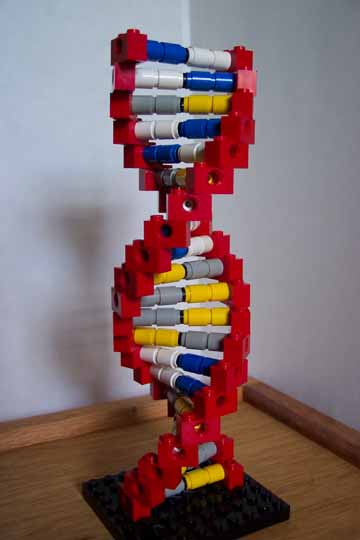
For those of you all out there who's unable to visualize the shape of "double helix" mean, hope this picture helps! =)
If you're wondering if it's made of LEGO, you are not wrong! =)
QN: If you stretched out your entire DNA from just one cell, how long would it be?
Answer: 2 metres! (no, this is definitely NOT a joke!)
Note: Photo courtesy of http://www.ericharshbarger.org/lego/mini_dna.html
Monday, January 29, 2007
DNA - Your Most Trusted Source of Identification
Titbits of the day
If you stretched out your entire DNA from just one cell, how long would it be?
Answers will be out on 1st of Feb. ^_^
Are identical twins Really identical?

After the chapter on Cells, some of you all have posed me the qn:
Are biological twins really identical in cells-wise?
well, here's the answer!
Although identical twins inherit the same DNA from their parents, the genome (DNA) is subject to changes as an individual grows and even influenced by its living environment.
Hence,even though identical twins are very similar as adults, the genome of each individual may be slightly different - due to mutations (remember our discussion on Cancer?) and the rearrangement of pieces of DNA - that have occurred uniquely in each twin, since the egg split.
A new term for you all to learn and impress your friends: Monozygotic twins
Monozygotic twins result when a single fertilised egg splits into two parts, each of which then forms a foetus in the womb. Therefore, identical twins are always of the same sex, and always contain identical DNA in their nuclei.
Mood lighting peps up spiders' sex life
![A spider weaves its web in a file photo. Lighting levels don't only affect human mating behavior -- scientists in Singapore have found certain types of light can make jumping spiders attractive to the opposite sex. [Reuters]](http://www.chinadaily.com.cn/world/2007-01/28/xin_1301042809178921230318.jpg)
HONG KONG - Lighting levels don't only affect human mating behavior -- scientists in Singapore have found certain types of light can make jumping spiders attractive to the opposite sex.
Writing in this week's issue of Science, the researchers said that when bathed in ultraviolet light, different parts of male and female jumping spiders glowed, making them appear sexually attractive.
"Males readily courted females by adopting a courtship posture comprising a flexed-up abdomen, arched legs and extended vibrating palps (an area near the mouth); females responded either with displays comprising hunched legs and bent abdomen or by briefly running away," they wrote in their article.
Once the light was turned off, the creatures -- known as Cosmophasis umbratica -- largely ignored one another.
"Without their partner in UV light, females showed no interest. When the females were not in UV light, the males ignored the females or responded with less interest," they wrote.
Article taken from: Here
Subscribe to:
Posts (Atom)
