In the Star Wars movie, ships could travel faster than the speed of light - cutting travelling time between galaxies and planets from years to minutes (imagine just taking a few days to reach the planet Mars for a holiday, wonderful right??!) , but then being all future scientists, Ponder for a moment: "is this possible in real life?" (even with future advancements in technology of course)
The speed of light, usually represented by the symbol "c" is exactly 299,792,458 metres travelled in 1 second and understandably, it is not easy to visualize how fast this is so we shall start with this. =)
One way to help all of us imagine would be to use the diagram below: 
The picture shows how short is the time (yes, 1 plus second) light takes to travel the distance between the Earth and the Moon. (a distance of 384,403 kilometres)
To explain the answer to whether can we travel faster than light or not, we'll use a formula (which I'm sure most of us have seen before but don't really understand) from Einstein's theory of relativity to put forward a simple proof =)
Einstein's theory of relativity states that:
where for any object, m refers to its mass, c refers to its speed and E the energy the object possesses.
oki, so what about the formula?
Einstein's relativity theory imposes a maximum limit to attainable speeds in the universe which means The law of relativity shows that the closer you get to moving at the speed of light, the higher the mass you have, and so the more energy you need to maintain your speed (and even more to keep getting faster). At the speed of light you will have infinite mass and so need infinite energy to be going that fast and that eventually you need infinite amounts of energy to accelerate infinite mass past the speed of light! (and as far as we know we have yet to find an infinite source of energy)
Just by way of comparison, the fastest speed ever achieved by an aircraft was 7,232 km/hour (Mach 6.7 - 6.7times the speed of sound) set by the experimental rocket-powered X-15 aircraft. That's 0.0000067 of the speed of light which really hints to us how far we're from hitting the speed of light.
X-15 Aircraft in flight.
All right, now for something additional =)
Have you ever wondered what will happen if we do travel faster than the speed of light?
(hint: our understanding of time changes !)
We can rely on the Special Theory of Relativity (Einstein 1905) and according to it :time in a moving reference frame (say your space ship) goes slower as compared to a stationary frame (say Earth) the faster you go.
So you see when you start off - at zero speed (0% of speed of light) your time is just regular i.e. the time slowing factor (xt) is equal to 1. As you speed up your time runs slower by the factor shown on the y-axis. As you are approaching 100% of the speed of light your time slows more and more until it is infinitely slowed down. (You should realize that everything slows down including your heart beats, your thoughts, etc.) So for an example if your ship goes at 98% of the speed of light and you take a one year journey, when you return to Earth five years have gone by.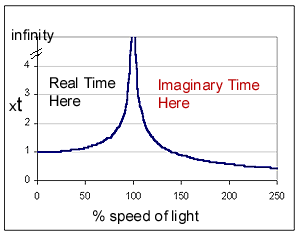
Another interesting phenomenon would be that if information could travel faster than c in one reference frame, causality would be violated: in some other reference frames, the information would be received before it had been sent (I'd receive a message from you even you have even sent out the message in your time of reference), so the 'effect' could be observed before the 'cause'.
Of course, there're much more to explore in possible effects if we do travel faster than time. If you're interested, this could be a possible area to research for your presentation. (hint: its under Quantum Physics)
xoxoxoxoxoxo
Science Teachers of LSS1
Saturday, July 21, 2007
Can Man travel at the speed of light?

Subscribe to:
Post Comments (Atom)

No comments:
Post a Comment