The African Wild Ass is a wild member of the horse family. This species is believed to be the ancestor of the domestic donkey which is usually placed within the same species. They live in the deserts and other arid areas of northeastern Africa, in Eritrea, Ethiopia and Somalia; it formerly had a wider range north and west into Sudan, Egypt and Libya. The upper parts of the African wild ass are gray; the mane is sparse but erect; and it has variable transverse leg stripes.
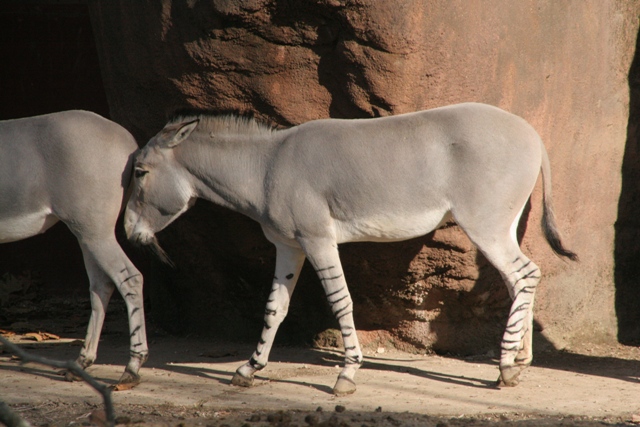
It has a length of about 2 m and weighs about 200 kg. The African wild ass is found mostly in hilly and stony deserts. It is an herbivore. Although the African wild ass is well adapted to life in the desert, it still needs access to water. It appears to be more active when the weather is cooler.
The African wild ass lives in groups that composed of fewer than 5 members. The groups are small due to the fact that food where the African wild ass is found is not suitable to support large groups. Adults males are often found living alone. However they may sometimes live in groups with other males. Females and their offspring are often found living together.
African wild asses are well suited to life in a desert or semi-desert environment. The diet of African Wild Asses consists of grasses, bark, and leaves. Despite being primarily adapted for living in an arid climate, African Wild Asses are dependent on water, and when not receiving the needed moisture from vegetation they must drink at least once every three days. However, they can survive on a surprisingly small amount of liquid, and have been reported to drink salty or brackish water. They have tough digestive systems, which can break down desert vegetation and extract moisture from food efficiently. They can also go without water for a fairly long time.
Their large ears give them an excellent sense of hearing and help in cooling. They have very loud voices, which can be heard for over 3 km, which helps them to keep in contact with other asses over the wide spaces of the desert.
Wild asses can run swiftly, almost as fast as a horse. However, unlike most hoofed mammals, their tendency is to not to flee right away from a potentially dangerous situation, but to investigate first before deciding what to do. When they need to they can defend themselves with kicks from both their front and hind legs.
The causes that result in the African wild ass becoming endangered are as follow: hunting the wild ass for food and medicinal purposes, potential competition with livestock for forage and water, and interbreeding with the domestic donkey.
Number of wild African wild ass in the world:
1968: few hundreds
1971: 3000
Early 1970's: 1500
1983: 2000
1992: Few hundreds
1997: Possibly only a few hundred animals
2002: Less than 570
The African wild ass is legally protected in the countries within which it is currently found, although these measures often prove difficult to enforce. More effective protection measures need to be adopted if the status of this species is to improve. A protected population of the Somali wild ass exists in the Yotvata Hai-Bar Nature Reserve in Israel, to the north of Elat. This reserve was established in 1968 with the view to bolster populations of endangered desert species. Populations of horses and asses are fairly resilient, and if the species is properly protected it may well recover from its current low.
Can you name other endangered species in the world?


No comments:
Post a Comment